
EPA Zone 1, What It Means in Northwest Georgia
The EPA radon zone map classifies every county in the United States by predicted average indoor radon screening levels. The map uses geological surveys, aerial radioactivity measurements, and soil characteristics to estimate radon potential by region.
Zone 1 is the highest designation. A Zone 1 county has a predicted average indoor radon screening level above 4.0 pCi/L, the EPA’s action level. Above that threshold, the EPA recommends mitigation. In northwest Georgia, Bartow, Floyd, and Cherokee counties all carry Zone 1 designations. Paulding County carries an elevated zone designation based on its geological connection to those same formations. You can verify county designations directly on the EPA Radon Zone Map.
The geology behind these designations is specific. The Blue Ridge and Valley and Ridge geological provinces run through northwest Georgia. The underlying rock in these formations is crystalline and high in uranium content. As uranium decays, it produces radium, which in turn produces radon gas. That gas migrates upward through soil and into the air spaces beneath and inside homes.
This is the same geological pattern that drives elevated radon across the full length of the Appalachian Mountains, from Pennsylvania and Ohio through Virginia, Tennessee, and into Alabama. Northwest Georgia is the southeastern extension of that belt. The Georgia Environmental Protection Division provides additional state-level radon data that reflects this regional pattern.
Cherokee County to the east and Cobb County to the southeast are also elevated. But Bartow and Floyd counties are consistently among the highest-risk counties in the state when measured against Georgia’s overall radon profile.
One critical point: Zone 1 is a predicted average, not a per-property reading. Individual homes vary based on foundation type, ventilation, construction details, and soil contact. Testing is the only way to know what is actually in a specific home’s air. To understand how Georgia homes interact with radon at the structural level, see Radon in Georgia Homes.

Bartow County, Cartersville and Surrounding Communities
Bartow County sits in the Valley and Ridge geological province of northwest Georgia. That province is one of the most radon-productive geological settings in the eastern United States. The ridges, valleys, and alternating rock formations that define the landscape are a direct result of the same geological forces that concentrate uranium in the underlying bedrock.
Cartersville is Bartow County’s largest city and the commercial and residential center for this part of the state. The surrounding residential areas include older downtown neighborhoods as well as newer suburban development that has expanded outward over the past two decades.
What the geology means in practice is straightforward: homes throughout Bartow County sit above rock with elevated uranium content regardless of where within the county they are located. Radon migrates upward year-round. There is no season when this stops.
Bartow County’s housing stock reflects two different risk profiles. Older homes built between the 1940s and 1970s typically have more foundation entry points, block foundations, unfinished crawlspaces, older slab construction with more cracking. Newer post-2000 subdivisions built on Zone 1 soil are not exempt. New construction does not change the geology beneath the foundation. Both categories require testing to know actual indoor levels.
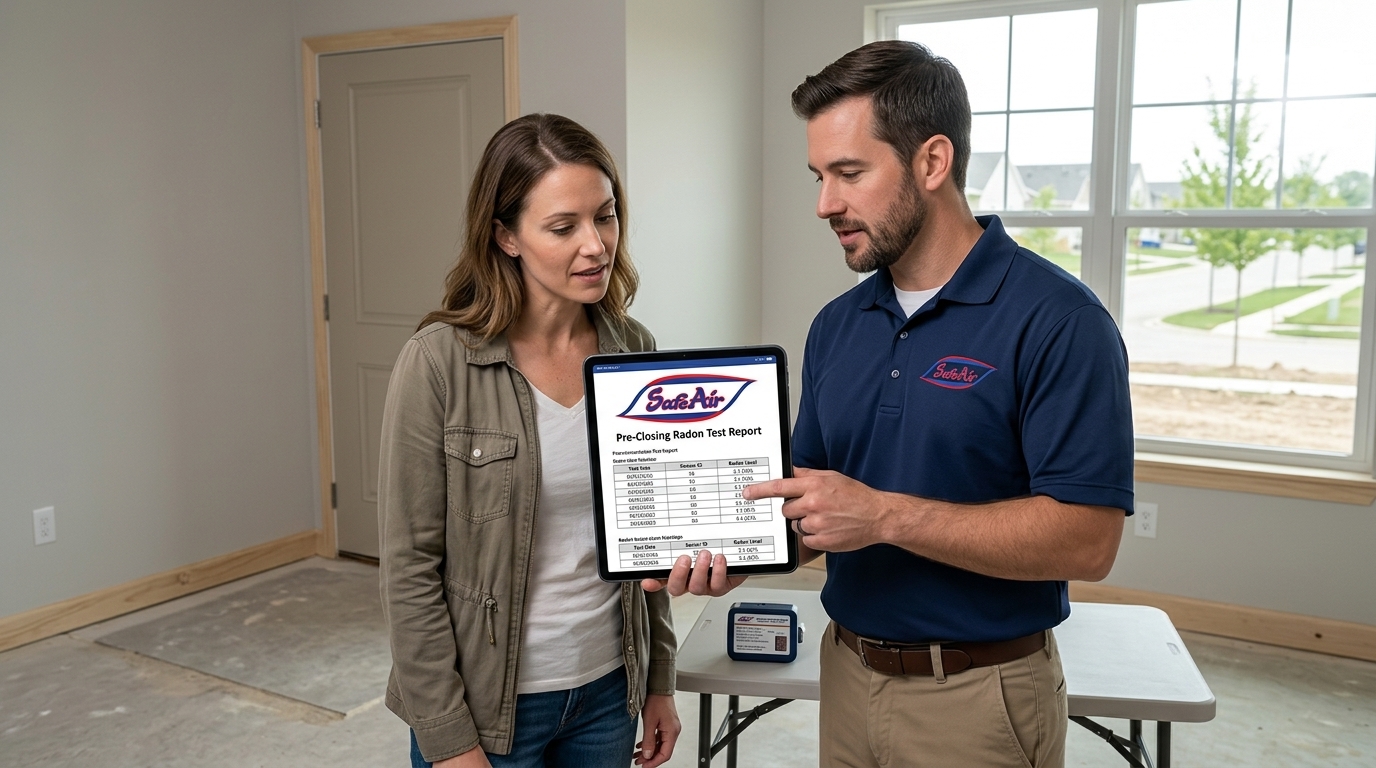
For buyers coming into Bartow County from metro Atlanta, the Zone 1 designation is often unknown until a certified inspector flags it or the buyer researches the county independently. Pre-listing radon tests help sellers avoid a transaction variable that comes up late in the process. A documented test result, below 4.0 pCi/L, is a factual selling point that reduces negotiation friction.
SafeAir serves Cartersville and Bartow County. Same-day scheduling is available. See the Cartersville service area page for scheduling details and coverage.
Paulding County, Hiram, Dallas, and the I-20 Corridor
Paulding County sits along the I-20 corridor west of Cobb County in northwest Georgia. The county carries an elevated radon designation based on its geological connection to the crystalline rock formations found in the Zone 1 counties to the north. Paulding is not classified as Zone 1, but its elevated designation reflects meaningful radon potential based on the same regional geology.
Paulding County’s residential growth over the past decade has been significant. Hiram and Dallas have been among the fastest-growing areas in the broader metro Atlanta region. A large number of new homes have been built across the county during this period, many of them on elevated-zone soil.
New construction in Paulding County carries the same geological baseline as existing homes. The soil and rock beneath a new subdivision in Hiram or Dallas do not change because the homes are newly built. Radon entry through slab joints, utility penetrations, and foundation gaps is a structural consideration regardless of how recently the home was constructed.
Older homes in western Paulding County present a different version of the same issue. More rural properties with crawlspaces and older foundation construction have additional structural entry points on top of the elevated geological baseline. That combination warrants testing regardless of when the home was built.
Paulding County’s real estate market moves buyers from Cobb County and central metro Atlanta westward in search of more affordable options. Many of those buyers are not aware of the area’s radon profile before they are under contract. A radon test during the inspection period is a straightforward way to get the information before closing.
SafeAir serves Hiram, Dallas, and Paulding County. Service area details are available for Hiram and Dallas.